Water exercise for Parkinson’s disease: Benefits, safety, and simple routines
February 3, 2020



A Parkinson’s diagnosis can change how you think about movement.
Things that once felt automatic — walking across a room, keeping your balance, getting through a workout — can take more focus and intention. But staying active is still one of the most important things you can do for your health.
The challenge is finding exercise that feels safe, manageable, and something you can stick with.
That’s where water exercise can make a difference.
What are the benefits of exercise for Parkinson’s disease?
Regular movement supports both the body and the brain. Research shows that exercise can help improve balance, maintain strength, and support mobility for people living with Parkinson’s.
One study that was presented at a Future Physiology studied 25 people with mild to moderate
Parkinson’s disease. Each participant took a one-hour circuit training class each week over varying periods, from one year to three years.
The participants were tested at the beginning of the study, as well as every four months. The results showed that the circuit training helped participant improve cognitive performance, as well as maintain strength. “Standardized physical tests, such as bilateral grip strength and the six-minute walking test did not significantly decrease over any of the time periods studied and there was improvement in the number of one-minute sit-to-stands after the first four months, from 21 to 23,” researchers wrote.
Exercise may also help the brain use dopamine more efficiently, which plays a role in movement control for those with Parkinson’s.
Over time, consistent exercise can help you maintain independence, improve coordination, and support overall quality of life. For many people, the key isn’t finding the perfect workout — it’s finding something they can continue doing.
Why water exercise works well for Parkinson’s
Water changes how your body moves.
Instead of working against gravity alone, you’re supported. That support can make movements feel more controlled and less risky, especially if balance is a concern. At the same time, water creates natural resistance, helping to build strength without putting added stress on joints.
Aquatic therapy has been shown to support balance and functional mobility, sometimes more effectively than land-based exercise alone.
In practical terms, that means you can move with more confidence while still working on strength, coordination, and endurance.
What water exercises can help with Parkinson’s symptoms?
You don’t need a complicated routine to see benefits. Simple, controlled movements are often the most effective.
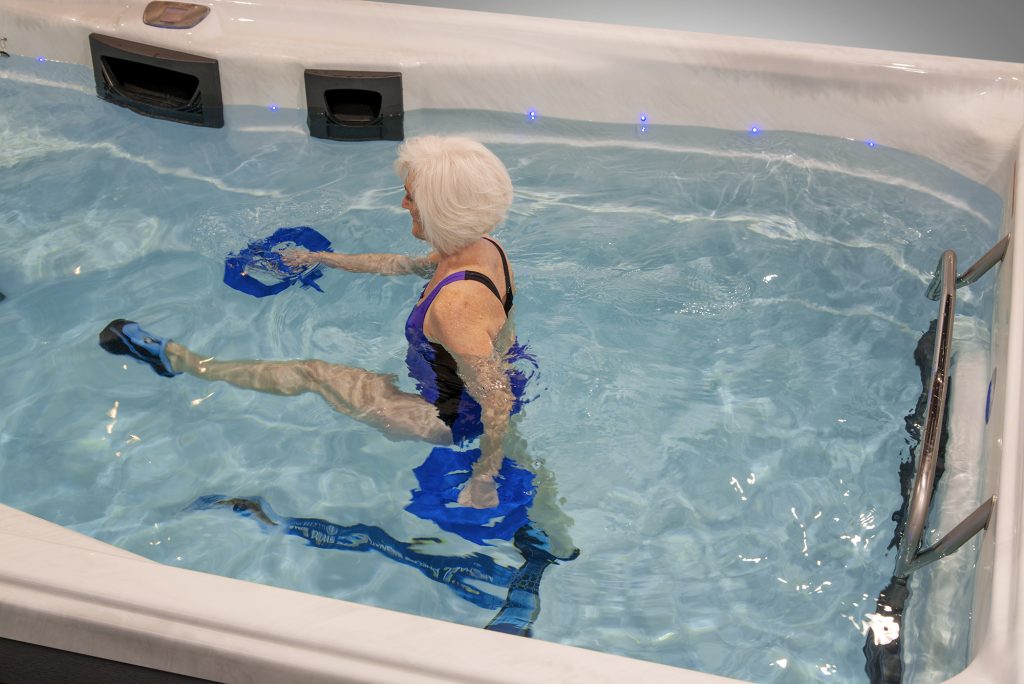
Walking forward and backward in the water, stepping side to side, or practicing sit-to-stand movements can all help improve balance and stability. Gentle arm movements against the resistance of the water can support strength, while marching or light jogging in place can build endurance.
Over time, these movements can be combined into a short, circuit-style routine. This type of structured exercise has been shown to help maintain strength and support cognitive performance in people with Parkinson’s.
Is water exercise safe for people with Parkinson’s?
For many people, water exercise is one of the safer ways to stay active.
The buoyancy of the water helps reduce the risk of falls and makes it easier to recover your balance if you feel unsteady. Being in a controlled environment also allows you to move at your own pace without pressure.
Warm water can play an important role as well. It can help relax muscles, reduce stiffness, and make movement feel more comfortable, especially at the start of a session.
How often should you do water exercise?
Consistency matters more than intensity.
General guidelines often suggest around 150 minutes of activity per week, but that can be broken into shorter sessions depending on your comfort level and schedule. Even a few sessions a week can support mobility and overall wellness.
The goal isn’t to push harder. It’s to keep moving in a way that feels sustainable.
Making it easier to stay consistent
One of the biggest challenges with any exercise routine is sticking with it.
Access can be a real barrier. Not every fitness center has a warm-water pool or offers aquatic therapy programs, and even when they do, schedules don’t always line up with your day. Getting there, changing, and planning around class times can add friction that makes it harder to stay consistent.
That’s where the environment matters.
Having access to a controlled, comfortable space at home can make it easier to build a routine. A swim spa allows you to exercise on your schedule, adjust the water temperature for comfort, and move at your own pace. It also gives you the option to combine exercise with hydrotherapy, which can help ease stiffness after a session.
For someone managing Parkinson’s symptoms, removing those barriers can make a meaningful difference in how often you’re able to stay active.
There’s no single solution for managing Parkinson’s disease. But staying active — in a way that feels safe and manageable — can support how you move and how you feel over time.
Water exercise offers a practical way to build strength, improve balance, and maintain mobility in an environment that works with your body instead of against it.